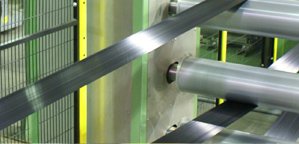
Geotextile for Garden Paths

Geotextile Range
Price list of 30.03.2026
| Name | Density, g/m2 |
Rupture strength, along length/ along width kN/m |
Elongation at rupture not more than, % |
Thickness at load of 2 kPa, +/- 0.5 mm |
Roll length, m (roll width of) |
Price in UAH, m2 with VAT |
| Heat-treated (calendered) geotextiles - stamp production technology (roll width 1,0; 1,5; 2,0; 3,0 m) | ||||||
| Runo К 100 | 100 | 2,8/2,8 | 25-80/35-90 | 0,5 | from 100 | 22,50 |
| Runo К 150 | 150 | 4,0/3,8 | 25-80/35-90 | 0,7 | from 100 | 29,28 |
| Runo К 200 | 200 | 5,4/6,0 | 25-80/35-90 | 1,0 | from 100 | 37,68 |
| Runo К 250 | 250 | 7,2/9,1 | 25-80/35-90 | 1,5 | from 100 | 44,70 |
| Runo К 300 | 300 | 8,6/10,9 | 25-80/35-90 | 2,0 | from 100 | 52,62 |
| Heat-treated (chemically bonded) geotextiles - staple production technology (roll width 1,0; 1,5; 2,0; 3,0 m) | ||||||
| Runo Р 100 | 100 | 6,5/3,8 | 25-80/35-90 | 0,5 | from 100 | 25,86 |
| Runo Р 150 | 150 | 9,0/3,8 | 25-80/35-90 | 0,7 | from 100 | 33,33 |
| Runo Р 200 | 200 | 12,0/7,4 | 25-80/35-90 | 1,0 | from 100 | 43,32 |
| Runo Р 250 | 250 | 14,0/9,6 | 25-80/35-90 | 1,5 | from 100 | 55,20 |
| Runo Р 300 | 300 | 15,0/10,9 | 25-80/35-90 | 2,0 | from 100 | 63,60 |
| Heat-treated geotextile - spunbond production technology (roll width 1,0; 1,5; 3,0 m) |
||||||
| Runo S 100 | 100 | 4,0/3,0 | 50/50 | 0,7 | from 100 | 22,50 |
| Runo S 150 | 150 | 5,5/4,5 | 50/50 | 0,95 | from 100 | 29,28 |
| Runo S 200 | 200 | 9,5/7,5 | 50/50 | 1,2 | from 100 | 37,68 |
| Runo S 250 | 250 | 11,0/9,0 | 50/50 | 1,5 | from 100 | 47,70 |
| Runo S 300 | 300 | 13,0/12,0 | 50/50 | 2,0 | from 100 | 52,62 |
| Geotextiles are heat-treated, chemically bonded - spunbond production technology (roll width 1,0; 1,5; 3,0 m) |
||||||
| Runo SP 100 | 100 | 5,0/3,0 | 22/24 | 0,7 | from 100 | 25,86 |
| Runo SP 150 | 150 | 8,8/6,6 | 23/24 | 1,0 | from 100 | 33,33 |
| Runo SP 200 | 200 | 12,4/9,8 | 24/25 | 1,2 | from 100 | 43,32 |
| Runo SP 250 | 250 | 14,0/12,0 | 30/30 | 1,4 | from 100 | 55,20 |
| Runo SP 300 | 300 | 16,0/14,0 | 30/30 | 1,6 | from 100 | 63,60 |
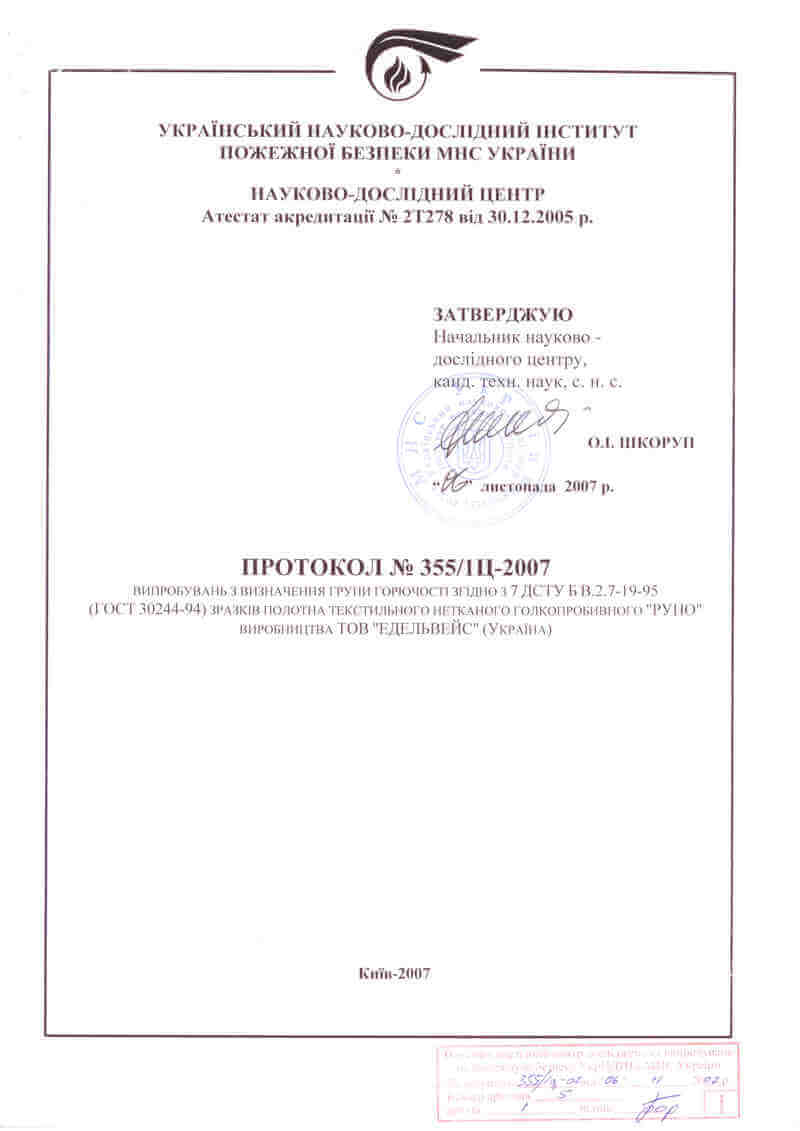
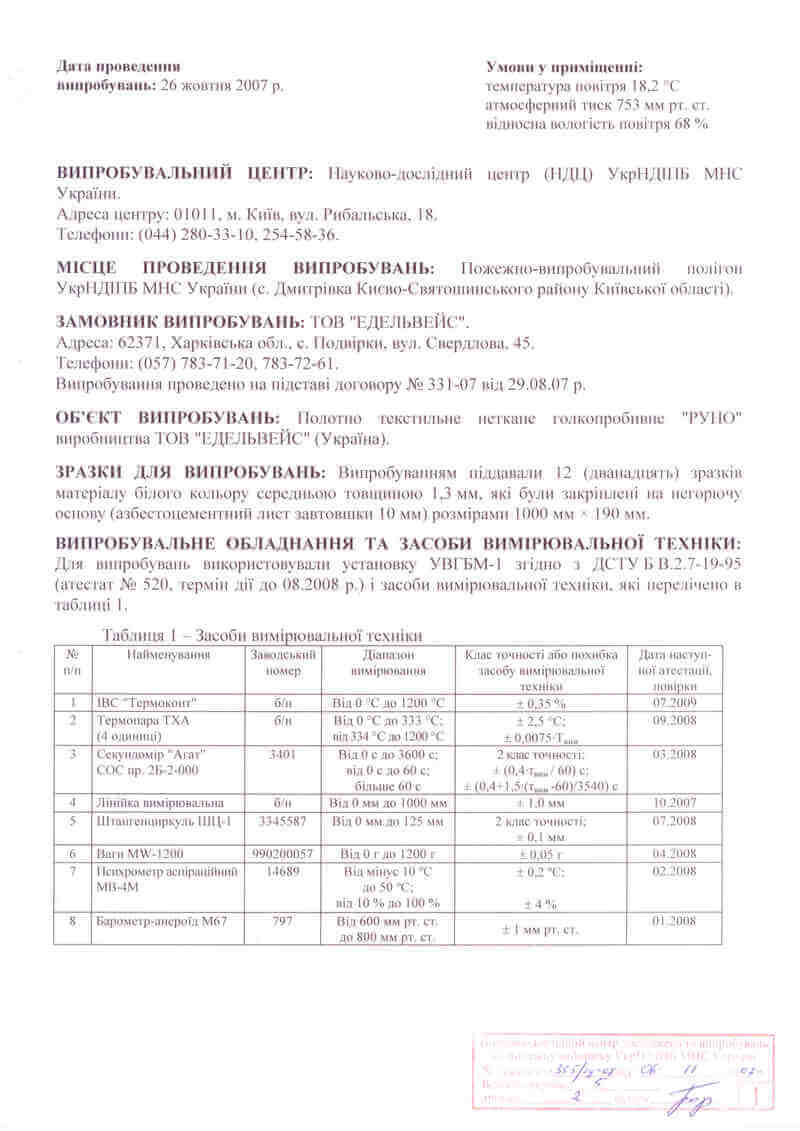
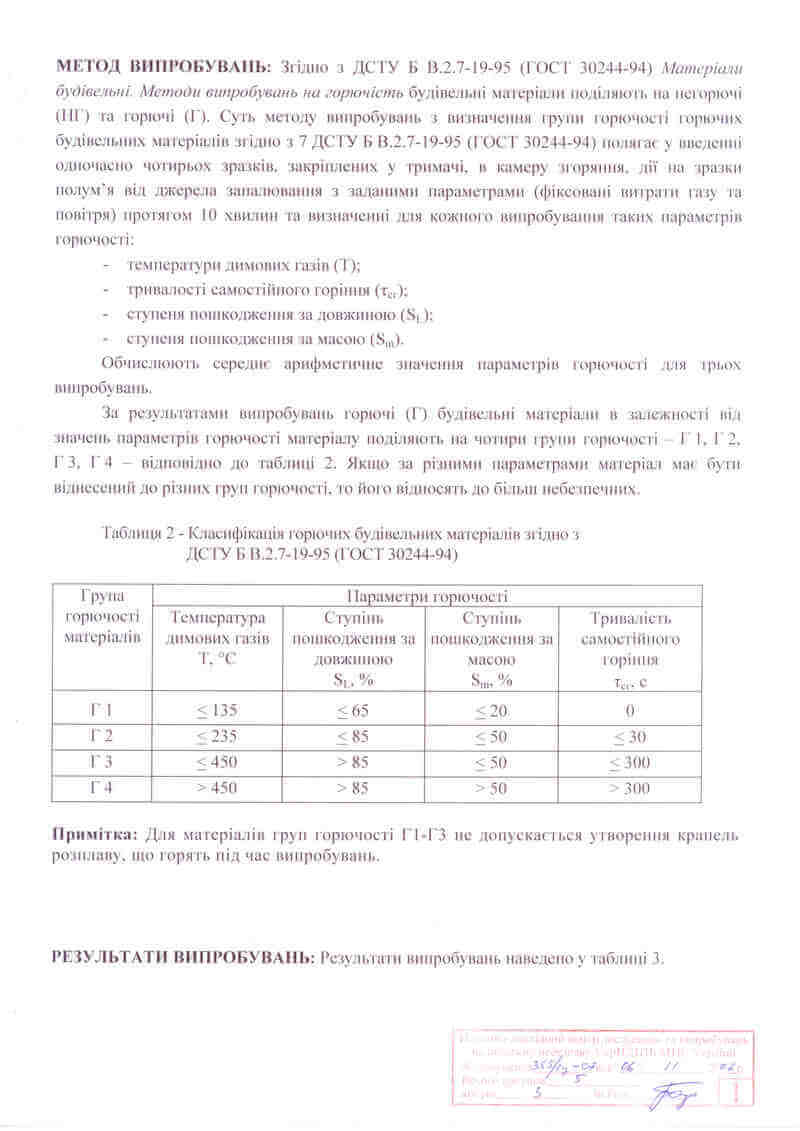
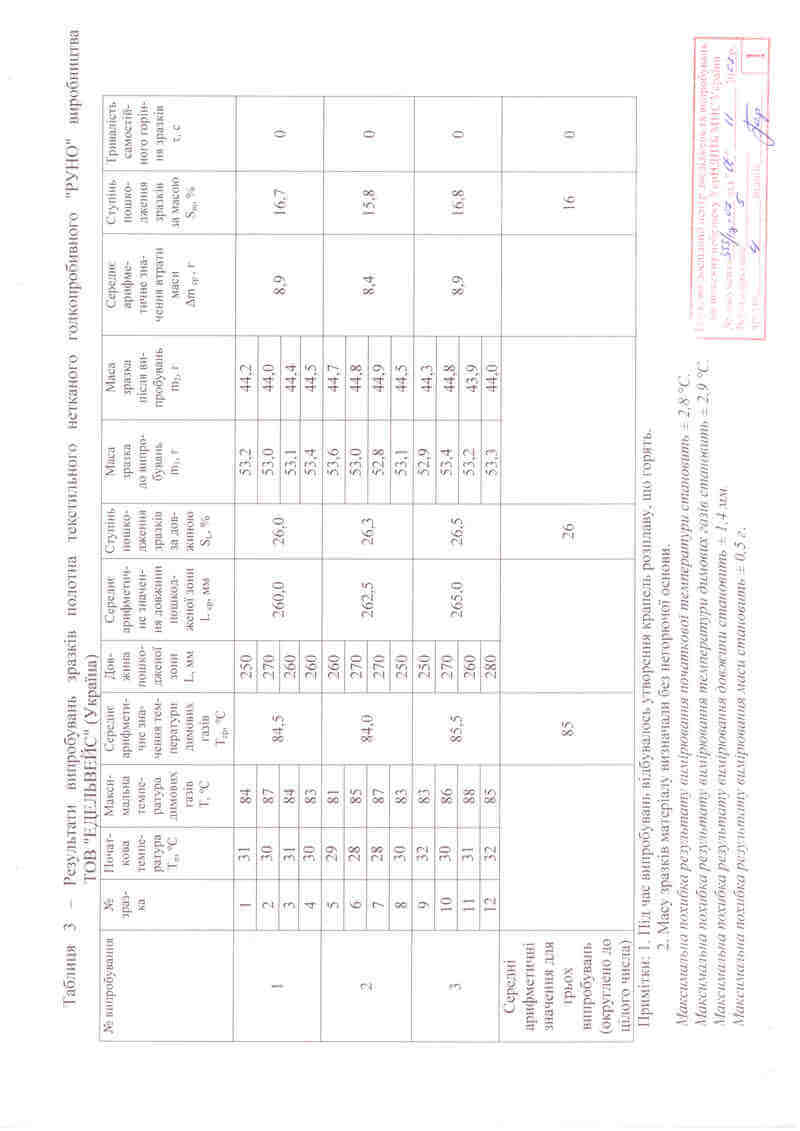
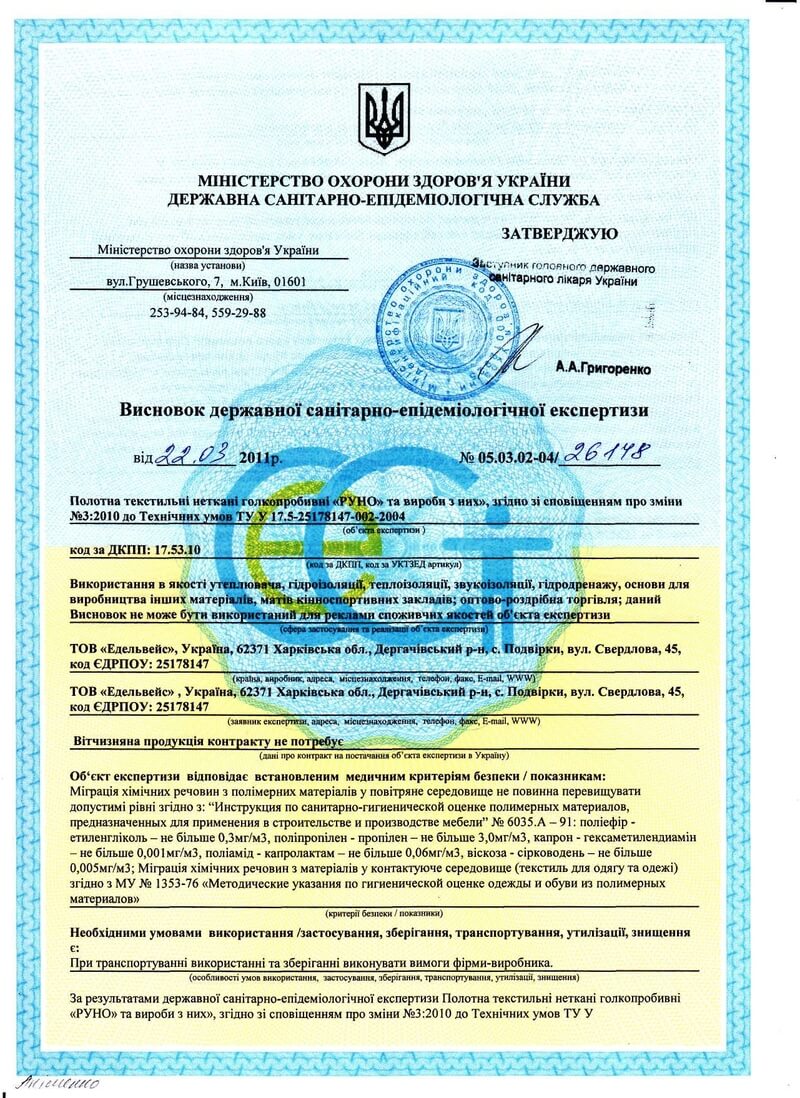
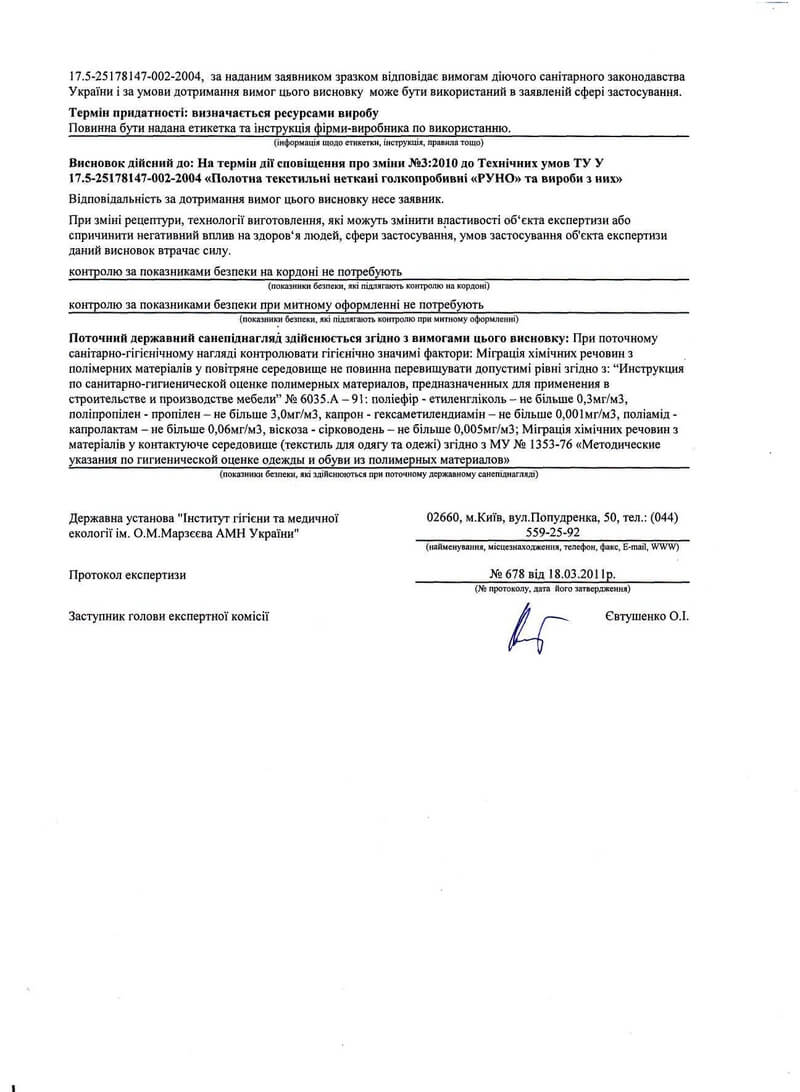
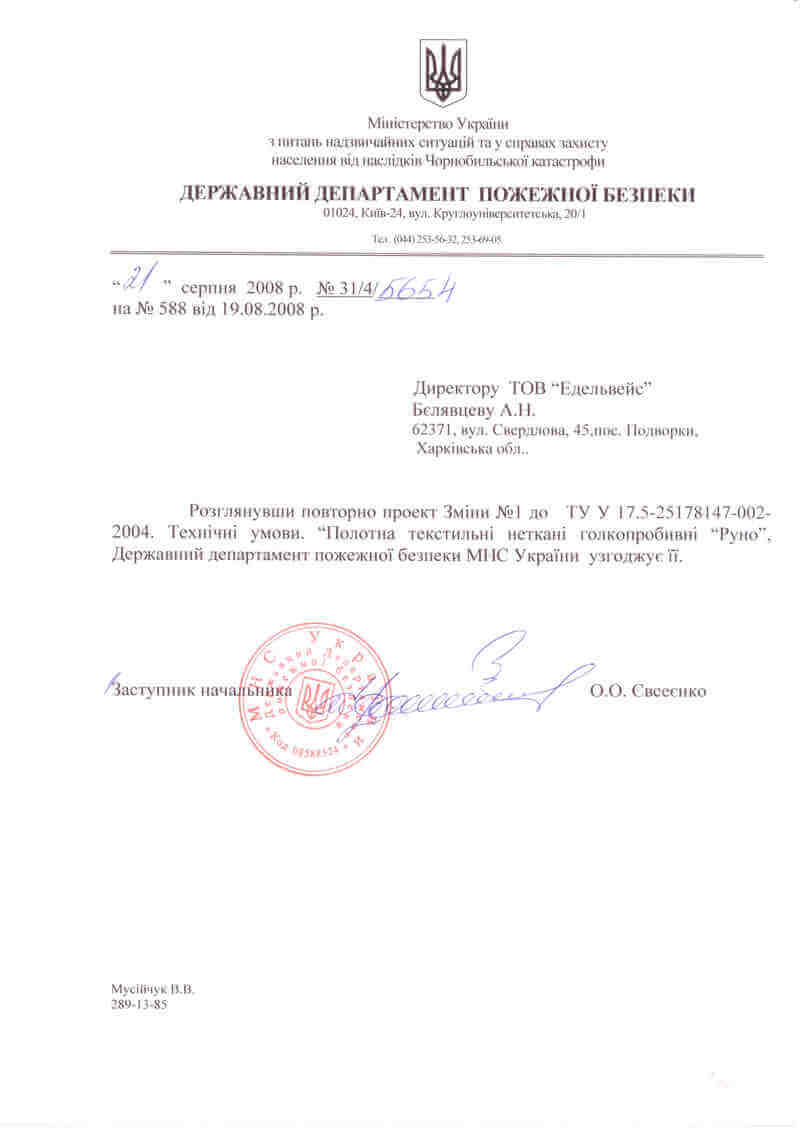
Certificates for geotextiles

Paths in a garden, summer cottage, or private yard are laid to provide passage between flower beds, tree rows, vegetable beds, and functional zones (for relaxation, barbecues, or children's games). They are narrow (up to 1.0 m wide), have a simplified base, and are covered with gravel, tree cuttings, paving slabs, or concrete slabs. Such paths are not subject to heavy or intense loads. To keep their surface even, a geotextile fabric (agrotextile) is laid in the road pavement structure. If you need high-quality geotextile for paths in Ukraine, you can buy it directly from the manufacturer, Flexx.
What is geotextile for garden paths?
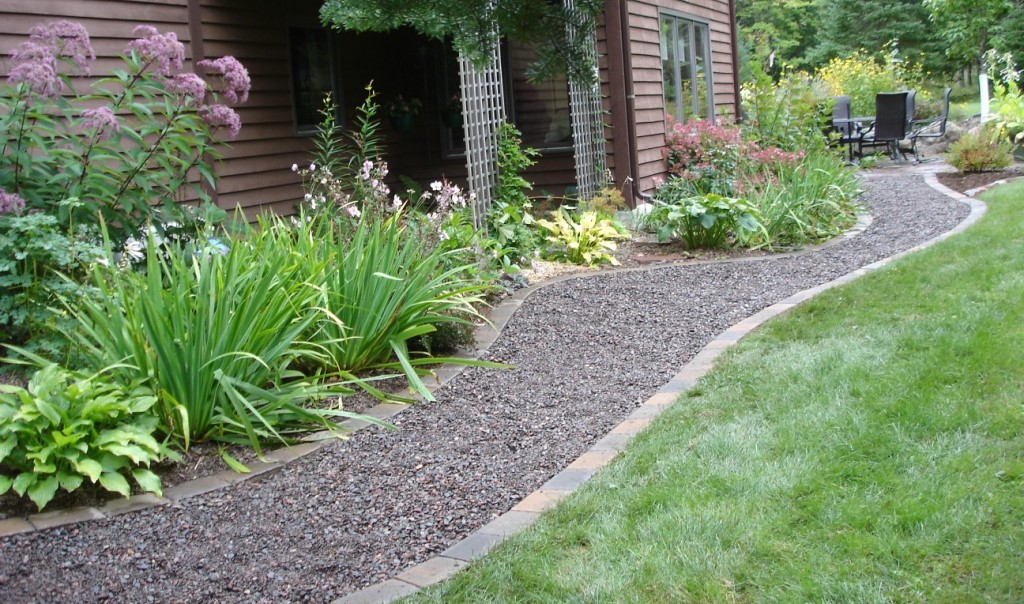
Geotextile fabric for paths is a non-woven roll material made from polyester fibers. The following types of agrotextiles can be used to arrange paths on a private residential plot:
- Runo K is a needle-punched, heat-treated (calendered) geotextile, produced by “staple” technology, which involves the use of short fibers. These are randomly laid out on a conveyor belt and become entangled with each other when passing through a needle-punching machine. Subsequent calendering increases the geotextile’s tensile strength and abrasion resistance, and reduces fiber shedding.
- Runo P is a needle-punched, heat-treated, and chemically bonded geotextile, manufactured from staple (short) fibers. Impregnation with special compounds makes the material denser, reduces its filtration capacity, and increases its resistance to UV, decay, mold formation, and the effects of aggressive substances.
- Runo S is a needle-punched, heat-treated geotextile manufactured by “spunbond” technology from long PET threads (filaments) obtained by extruding molten polymer through spinnerets. Fabrics of this brand pass through a needle-punching machine and heated rollers (calenders).
- Runo SP is a type of Runo S spinneret fabric produced by “spunbond” technology, and reinforced with chemical impregnation.
Given the narrow width of paths and driveways for garden carts or lawn mowers, geotextile for paths in the country is typically selected in a width of 1.0 or 1.5 m. This material is produced in long sheets (100, 150, 200, 250, and 300 m), which are rolled up for convenient storage, transportation, and installation.
Geotextile for garden paths specifications
Geotextile fabric with the following specifications is suitable for constructing garden paths:
- Surface density: 100 g/m² (Runo P, Runo S, and Runo SP) or 150 g/m² for any of the four brands listed above. For wet soils, it is better to choose a denser geotextile – 200 g/m².
- Tensile strength along the fabric length (width): from 4.0 (3.0) to 12.4 (9.8) kN/m.
- Relative elongation at break (in the longitudinal and transverse directions), in %:
- Runo K 150 – 30/50.
- Runo P 100 – 20/28.
- Runo K 200 – 40/60.
- Runo P 150 – 22/30.
- Runo P 200 – 22/35.
- Runo S (100, 150, and 200 g/m²) – 50/50.
- Runo SP 100 – 22/24.
- Runo SP 150 – 23/24.
- Runo SP 200 – 24/25.
- Thickness under 2 kPa load, mm: from 0.5-0.7 to 0.8-1.1 (1.2 for Runo S and Runo SP grades).
- Operating temperature range: from −50 to +200 °C.
Tasks solved by geotextile
Geotextile used for paths in the yard of a private house, in a summer cottage, or garden plot performs a number of functions essential to the stability and durability of the road structure:
- It strengthens the path base, preventing its subsiding and deformation, as the load on the ground from the foot traffic and garden equipment is evenly distributed over a large area.
- It separates the layers of the path structure, preventing intermixing of soil with gravel, and gravel with sand, which keeps the path structure stable over a long period of time.
- It prevents water stagnation and sand or soil particles from washing out. Thanks to its ability to pass water through while retaining fine solids, the geotextile fabric protects the drainage system from clogging.
- It prevents weed growth through cracks in the final surface, blocking vegetation under the path structure without herbicides.
- It helps maintain the path’s shape on loose soil and slopes.
In addition, the use of agrotextile reduces the installation time and material costs required to lay a garden path.
How to choose geotextile for garden paths?
When choosing a geotextile for paths in a cottage house, household plot or garden, you need to follow this algorithm:
- Determine the type of path and the load on it:
- Decorative with a light load.
- Frequently used pedestrian with medium load.
- For pedestrians and garden equipment with increased load.
- Based on the type and load, determine the appropriate geotextile density:
- For light load – 100 g/m2.
- For pedestrian garden paths with medium load – 150 g/m2.
- For paths designed for garden equipment – 200 g/m2.
- Choose the geotextile grade. If the path is laid on clay soil or in a low-lying area, you should choose a material with high water permeability (Runo K or Runo S), and on loose soils – chemically treated fabrics (Runo P or Runo SP).
To eliminate the risk of the garden path sinking, choose a geotextile with lower relative elongation. If you have any questions about material selection, please contact the Flexx experts for assistance.
Laying geotextile for paths
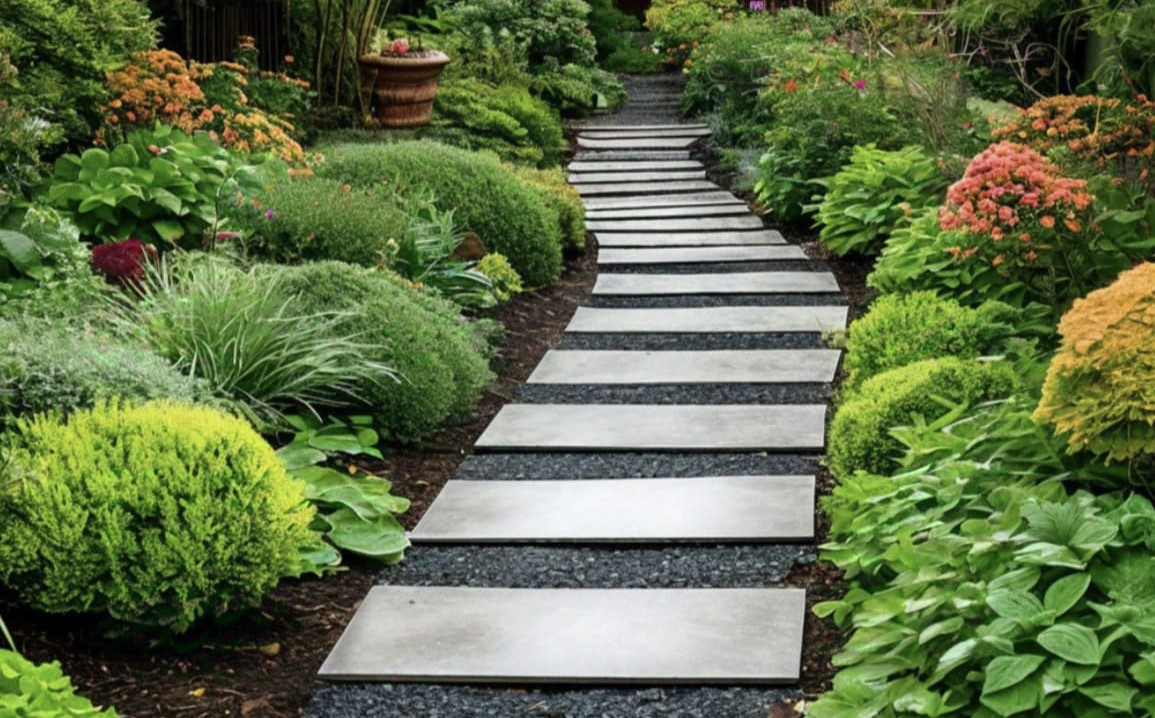
Installation of a garden path with geotextile should be carried out in the following sequence:
- Mark out the path with stakes and string to the width of the future path, adding a 10-15 cm allowance on both sides.
- Remove the top layer of soil together with roots and turf to a depth of 20-30 cm.
- Level the excavation bottom. If necessary, provide a 1-2% crossfall to ensure water runoff.
- Compact the soil base.
- Lay the geotextile and secure it on both sides with a border or barrier. For long paths, install the sheets with an overlap of 10-20 cm and fix them with construction staples.
- Fill the bearing layer of the path (with crushed stone, gravel, or sand).
- If there are several fill layers, compact the bottom layer and place another geotextile sheet on its top.
- Lay the final covering.
Why is it profitable to buy geotextile for paths from Flexx?
If you need geotextile for garden paths at a favourable price, it is worth buying it from our company. The key advantages of buying from us are:
- High-quality geotextile by Flexx that meets high international standards.
- Wide assortment with expert assistance in selecting the right material.
- Affordable prices without overpaying intermediaries.
- Fast order processing and on-time dispatch.
- Official manufacturer's warranty.
Order geotextiles for paths by calling the number listed at the top of the website or via the feedback form by clicking the “Contact us” button.